| Solar45. The development funding gap. |
There is a point in the life of a solar project where the money gets difficult, and it is not the point most people expect.
Everyone understands that building a solar farm costs money. What is less understood is that by the time construction begins, the financing is usually the easy part. Banks, infrastructure funds and institutional buyers compete hard for projects that are permitted, grid-connected and ready to build. That end of the market is well served.
The difficulty sits earlier. Between securing land and reaching Ready-to-Build status, a project has to be taken through permitting, environmental process, engineering and grid connection. That work costs real money, takes years, and carries genuine risk that the project does not make it through. Most institutional capital will not touch it. Most developers cannot fund it alone.
That gap is where value is created, and it is the gap that Solar45 is built to address.
Why the gap exists
The reason is structural rather than anything to do with Portugal specifically.
Large institutional investors are mandated to hold assets with predictable, contracted cash flows. A permitted, construction-ready solar project fits that mandate. A field with a land option and a planning application does not. The risk profile is different, the time horizon is different, and the expertise required to assess it is different.
So the market splits. Enormous quantities of capital chase finished projects, compressing what buyers can earn from them. Comparatively little capital is available for the work of turning raw sites into finished projects, even though that is precisely where the difficult, value-creating work happens.
Anyone who can do that work competently is producing something the market genuinely wants and cannot easily produce for itself.
What the work actually involves
It is worth being concrete, because development sounds abstract until you list it out.
- Identifying land with both a strong solar resource and a realistic route to grid connection, which is a much narrower set of sites than it sounds.
- Securing land rights on terms that survive the years the rest of the process takes.
- Working through environmental licensing and planning permission, with the local knowledge and relationships that process demands.
- Navigating the grid connection process, which is as much about timing and relationships as engineering.
- Packaging the result into something an institutional buyer can underwrite without having to redo the work.
None of this is glamorous. All of it is where the margin lives. A project that has cleared these hurdles is worth considerably more than the sum of the land and the paperwork, because someone has absorbed the risk and uncertainty of getting it there.
Why Portugal, and why now
Portugal has made this kind of development materially more viable than it would be in most European markets.
The Acordo Scheme simplifies permitting and speeds project development, prioritising high-impact solar assets and aligning environmental, planning and grid approvals rather than leaving developers to run three separate gauntlets. Reforms to licensing have reduced complexity further. The framework is overseen by DGEG, the national energy authority, which has been notably willing to remove friction rather than add it.
Behind that sits a national commitment to renewable capacity growth, an exceptional solar resource, and grid investment that accelerated sharply after the Iberian blackout made transmission resilience a political priority. I have written more on how Europe’s solar market has split between listed and private capital and on why Portugal’s regulatory direction is worth watching.
The honest framing
Development-stage exposure is not for everyone, and I would be doing a disservice to pretend otherwise. It carries risks a completed, contracted asset does not. Permitting can stall. Grid queues can move. Projects can fail to reach Ready-to-Build at all. Anyone considering this space needs to understand that clearly before anything else.
What I can say is that the risk is legible. It is execution risk and process risk, assessed by looking at the team, the sites, the track record and the market. That is a more tractable question than guessing where power prices land in a decade.
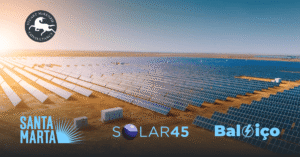
Solar45 is introduced by Univere Investments for qualified professional investors, and continues development on the Santa Marta site I wrote about separately. The proper conversation starts with the documentation rather than a summary, and you can read more on the Solar45 page.
Two related strategies sit on the same thesis. I have written separately about Santa Marta, the asset this development continues, and I am writing about Baloiço, which integrates solar with storage across the Iberian region. Both are worth reading alongside this one. Stay tuned.
If you want to understand where development-stage energy sits within a wider portfolio, I am happy to talk it through. More at Stuart McKenzie Consultancy.
The strategies referenced are intended for qualified professional investors and are not offers or invitations to invest. Nothing here is investment, legal or tax advice. Please take appropriate professional advice before making any decision.