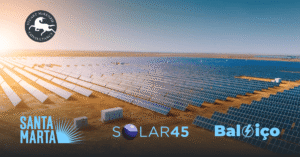
| Santa Marta. The origin story. |
Development on the Santa Marta site in the Algarve began in 2019. Seven years later it is still being advanced.
I lead with that because it is the part of energy investment nobody puts on a brochure. The public story of the energy transition is one of announcements and ribbon cuttings. The actual story is years of land agreements, environmental process, grid queues, engineering revisions and regulatory patience, long before anything is generating a single unit of electricity.
Santa Marta is a useful case study precisely because it has been in the ground, so to speak, for that long. It tells you something about what serious energy development actually requires, and about why location decisions made years ago matter enormously today.
Where a project sits decides what it is worth
The single most important fact about Santa Marta is not the solar resource, though the Algarve has one of the strongest in Europe. It is the grid.
The site sits adjacent to the Tavira 400kV transmission corridor, one of the highest-capacity grid connection points in southern Portugal. For anyone unfamiliar with why that matters, here is the short version. A solar project without a viable grid connection is a field with panels on it. The electricity has nowhere to go. Across Europe, gigawatts of otherwise viable renewable projects are sitting in connection queues that run to years, because the transmission networks were not built for the volume and geography of generation the transition requires.
A project positioned next to a high-voltage node is in a fundamentally different position. It has a route to market. It also sits close to the Portugal to Spain interconnection, which means exposure to cross-border electricity flows and the price dynamics of the wider Iberian market rather than a single domestic one.
That positioning was a decision made years ago by people who understood that grid access would become the scarce thing. They were right, and the rest of the market has spent the intervening years catching up to that view.
Why Portugal has become the place to do this
Portugal has spent the past few years quietly building the conditions that make large-scale renewable development work, rather than simply setting targets and hoping.
There is the resource itself, with over three thousand hours of sunshine annually in the south. There is the regulatory framework overseen by DGEG, Portugal’s national energy authority, which has moved to simplify permitting rather than let it calcify. And there has been a material acceleration in grid investment, particularly following the Iberian blackout, which turned transmission resilience from a technical footnote into a national priority.
I have written elsewhere about why Portugal keeps appearing in serious energy conversations and about why the value in solar has moved well beyond the panels themselves. Santa Marta is where those two arguments meet in a single physical location.
The storage question
Santa Marta also carries potential for battery storage integration, and this is where the project becomes more interesting than a conventional solar development.
Solar generation peaks in the middle of the day. Electricity demand peaks in the evening. Across Iberia that mismatch has become an expensive structural problem, producing hours where prices collapse and clean generation is curtailed rather than used. A site with storage alongside generation can absorb power when it is abundant and release it when the grid actually needs it.
A location near a major transmission node and close to a cross-border interconnection is unusually well suited to that, because the price movements it can respond to are wider and more frequent than they would be somewhere less central to the system.
What I take from it
What I find instructive about Santa Marta is the timescale. This is not a story of spotting an opportunity and moving quickly. It is a story of holding a position through years of process, in a location chosen for reasons that only became widely obvious much later.
That is the nature of real infrastructure. The returns, where they come, are compensation for patience and for absorbing the complexity that others would rather avoid. It is also why I am generally sceptical of energy propositions that promise to be both simple and quick. The simple, quick version of this sector was arbitraged away some time ago.
Santa Marta is introduced by Univere Investments for qualified professional investors. It is not a retail product and I do not present it as one here. What I can do is explain why the underlying logic is sound, and the detail properly sits in the documentation rather than in any article.
Two related strategies build on the same thesis. I am writting separately about Solar45, which addresses the development funding gap, and about Baloiço, which integrates solar with storage across the Iberian region. Both are worth reading alongside this one. Stay tuned
If energy infrastructure is something you are weighing as part of a broader allocation, I am always glad to start with a conversation. More on how I work is at Stuart McKenzie Consultancy.
The strategies referenced are intended for qualified professional investors and are not offers or invitations to invest. Nothing here is investment, legal or tax advice. Please take appropriate professional advice before making any decision.