Last week the European Union admitted something it has been reluctant to say out loud for years. It is building clean power faster than it can use it.
On 26 June, EU energy ministers signed the bloc’s first-ever agreement dedicated to energy storage. The headline number is stark. Europe currently has around 55 gigawatts of storage capacity. It needs 200 gigawatts by 2030. That is not incremental. It is a near-quadrupling in less than five years, and it tells you exactly where the pressure in the European energy system now sits.
I have written before about why storage, not generation, is where the interesting investment questions live. This agreement is the clearest official confirmation yet that the market has reached the same conclusion.
The problem is a good problem, until it isn’t
For most of the last decade, the European energy story was about adding renewable generation. Solar panels, wind turbines, capacity, capacity, capacity. That worked. In 2025, wind and solar generated more EU electricity than fossil fuels for the first time in history. Solar alone supplied a record 25% of the bloc’s electricity in June, becoming the EU’s single largest source of power that month.
But generation without storage creates a peculiar failure. The sun produces most of its power in the middle of the day, when demand is not at its highest. The wind blows when it chooses. When supply outstrips what the grid can absorb, prices collapse, sometimes below zero.
The numbers here are striking. In the first quarter of 2026 alone, EU day-ahead markets recorded 1,223 hours of negative prices, roughly double the previous level, with Germany and Spain among the hardest hit. When prices go negative, grid operators curtail renewable output. Clean electricity that could have powered homes and industry is simply thrown away, and the projects that generated it lose revenue.
As one energy expert quoted by Euronews put it, Europe is already in a version of gridlock, with negative prices becoming common because there is a surplus of renewables and not enough storage to use that power later.
What the new agreement actually commits to
The agreement is a tripartite arrangement between member states, financial institutions and clean energy producers. Twenty-two national governments have signed. The collective goal is to add 30 to 35 gigawatts of new storage capacity by 2028, roughly doubling the current total.
The commitments vary widely by country. Poland has pledged 11,000 megawatts, Austria 5,000, and Portugal 500. The European Investment Bank plans to expand its power purchase programme and increase support for storage manufacturing.
There is an honest caveat, and I want to be clear about it. The agreement is not legally binding. It sets a political direction rather than a hard obligation. As the CEO of SolarPower Europe noted, the real test now is implementation. But even as a signal, it matters. It reframes storage from an optional add-on into a delivery priority, and that reframing is what capital watches for.
Why data centres make this urgent
There is a second force accelerating all of this, and it is one my clients ask about constantly. Artificial intelligence.
The International Energy Agency projects that AI and data centre electricity consumption will double by 2030. These facilities already account for around 3% of electricity supply. Crucially, they require constant, uninterrupted power. A data centre cannot pause its operations when a cloud passes over a solar farm.
Without large-scale storage, that 24/7 demand risks being met by fossil-fuel plants, which would undermine the entire decarbonisation effort. With storage, excess daytime solar can be banked and released overnight to keep digital infrastructure running on clean power. The energy transition and the AI buildout are now bound together, and storage is the knot that ties them.
Portugal is turning this into an opportunity
Nowhere is the link between AI, energy and storage clearer than in Portugal, and it is worth looking at closely because it shows the thesis in action.
Portugal is emerging as a significant European data-centre hub, with more than 2.6 gigawatts of capacity under development, including a major AI infrastructure investment backed by Microsoft. The appeal is straightforward. Portugal has abundant wind, solar and hydropower, which gives data-centre operators access to highly competitive renewable electricity. Wholesale power prices in the Iberian MIBEL market that Portugal shares with Spain averaged just above 40 euros per megawatt-hour in the first quarter of 2026, compared with more than 90 euros in most European markets. Its Atlantic coastline also makes it a natural landing point for the subsea cables that connect Europe, Africa and the Americas.
What I find telling is Portugal’s posture. Rather than accepting every power-hungry project that comes its way, the country is being selective. Infrastructure Minister Miguel Pinto Luz said plainly that data centres consume astronomical amounts of energy and sometimes generate few local benefits, and that Portugal wants investment that delivers real productivity gains rather than becoming, in his words, Europe’s dumping ground. That discipline is a good sign for the durability of the market being built there.
The connection to storage is direct. Data centres need constant power. Portugal’s cheap renewable generation is the draw, but storage is what allows that generation to meet round-the-clock demand without falling back on gas. The country that pairs low-cost solar with serious storage capacity is the country that captures this investment on the best terms.
What this means for investors
Here is the part that matters for how serious capital should be positioned.
When a major economic bloc publicly commits to quadrupling a specific type of infrastructure, and backs that with financing institutions and manufacturing support, it changes the risk profile of investing in that infrastructure. The political and policy risk that might otherwise deter long-term capital is reduced. The direction becomes visible.
Storage co-located with solar generation sits precisely at the centre of this. It solves the negative-price problem by capturing cheap surplus power and selling it when demand and prices rise. It diversifies a project’s revenue across arbitrage, balancing services and capacity markets. It turns the very volatility that damages simple generation assets into a source of return.
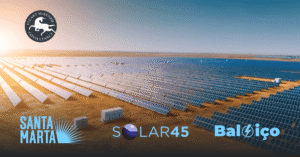
For professional investors who want to understand how private capital is being structured around this thesis, the Solar45 strategy at Univere Investments integrates solar development with co-located battery storage in Portugal, and the Baloico strategy takes a broader infrastructure lens to Iberian energy assets. Both are designed for qualified professional clients, and the detail sits in the documentation rather than any summary.
The bigger picture
I try not to get swept up in policy announcements, because a signed agreement is not the same as a built facility. Implementation is where ambition meets reality, and Europe has a long history of moving more slowly than its own targets suggest.
But the underlying logic here is sound and, more importantly, it is commercial. Storage is not being pursued out of idealism. It is being pursued because negative prices are wasting money, because gas still sets the electricity price whenever renewables fall short, and because the AI boom is about to place demands on the grid that intermittent generation alone cannot meet.
When the policy direction and the commercial logic point the same way, the investment case tends to be more durable. That is what I see here. Europe is finally racing to fix the thing that has been holding renewables back, and the assets positioned to solve that problem are the ones I would want to understand first.
If you are reviewing your energy infrastructure allocation, or thinking about it for the first time, I am happy to start with a conversation.