I keep a close eye on Portuguese energy policy because I have clients invested there, and also because Portugal often leads the way in energy initiatives that other European countries adopt later.
This week, there was news that didn’t get much international coverage but deserves more attention.
Portugal has just promulgated a new decree-law that simplifies and accelerates collective self-consumption and renewable energy communities across the country. In plain terms: producing and sharing renewable energy is now simpler, faster and cheaper for individuals, businesses, municipalities and local communities.
The numbers help explain the impact. Since April 2025, 800 new energy communities have connected to Portugal’s grid, bringing the total to 1,218 active projects. That’s about twice the growth seen in the previous two years, and the new rules aim to speed things up even more.
This is not a small regulatory tweak. It is part of a deliberate national strategy that the European Commission has already recognised as an example of good practice in renewable energy deployment.
What the New Rules Actually Change
The new law, passed on 5 June 2026, updates Decree-Law No. 15/2022 and brings several important changes:
- Wider geographic reach: The allowed distance between energy producers and consumers is now greater, so larger projects with more participants can be set up in one area.
- Reduced bureaucracy: The process is simpler now, and developers don’t have to consult the network operator as often before moving forward.
- More flexible participation: It’s now easier for new members to join projects and for those who want to leave to do so smoothly.
- Smaller installation exemptions: Installations up to 800 watts no longer need prior approval, an increase from the previous 700-watt limit.
- Stronger consumer protections: For the first time, there are official rules for collective self-consumption, focusing on transparency, consumer rights, and fair sharing of benefits.
- A national map: A public map is being created to show collective self-consumption projects and energy communities, so people and businesses can find and join nearby projects.
The government’s perspective is clear. The Minister of Environment and Energy, Maria da Graça Carvalho, said the goal is to make “producing and sharing renewable energy within reach of everyone, from individuals to businesses, from municipalities to local communities. Every solar panel that comes online means less energy we import and less money we pay to foreign countries.”
What This Signals About Portugal as an Energy Market
To be clear, I don’t focus on direct investments in collective self-consumption. These are community and small-scale projects, not the larger utility or fund-level infrastructure that matters most to my clients.
However, the regulatory changes are important, and they have a specific impact.
A country that is actively dismantling administrative barriers to distributed renewable energy participation is telling the market something important about its broader approach. Portugal is not managing the energy transition reluctantly, at the minimum pace required by EU targets. It is building the legal, regulatory and infrastructure architecture to embed renewable energy generation deeply into its economy, from household level upward.
I wrote recently about how the EU’s €25 billion T-MED Mediterranean energy initiative places Portugal within a much larger institutional capital flow. I also wrote about why Portugal’s grid hybridisation approach is ahead of most European markets. This week’s decree-law adds another layer to that picture.
The country has strong solar irradiance. It has already hybridised renewable projects with battery storage in ways that other European markets have not yet managed at scale. It has a grid policy framework that is ahead of many of its peers. The IEA’s Renewables 2024 report consistently places southern Europe among the most cost-advantaged regions for solar generation globally. And now Portugal is simplifying the participation of its own citizens and businesses in the energy transition, creating broader domestic buy-in for the infrastructure that larger-scale investors are building alongside it.
This kind of alignment between national policy, community involvement, and big investments isn’t common in energy markets. When it does happen, it usually leads to a more stable environment for new projects.
Portugal, the Golden Visa and the Energy Thesis
My clients come to Portugal for two main reasons. Some are interested in investment migration, like the Golden Visa, fund options, or residency leading to EU citizenship. Others want to know where in Europe investing in solar and storage makes the most sense right now.
More and more, both groups find that Portugal is the answer.
Portugal’s Golden Visa fund route requires a minimum €500,000 qualifying investment in a CMVM-registered fund investing substantially in Portuguese commercial activity. When the underlying fund is itself invested in energy infrastructure with genuine structural tailwinds, backed by the kind of regulatory environment this week’s news reflects, the investment is doing more than securing a residency position. It is participating in an economy that is deliberately repositioning itself around renewable energy.
That’s a more appealing option than a residency program based only on a passive investment.
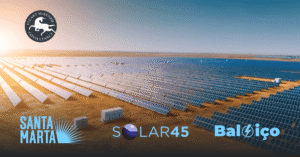
For those interested in the Portugal residency route, Elite Golden Visa handles the application process, legal requirements and practical realities on the ground with considerable experience. For qualified professional investors wanting to explore how energy infrastructure exposure and Portuguese residency can work together within a single structure, the New Frontiers Energy Fund at Univere Investments is designed around exactly that combination: a genuine energy transition thesis with Golden Visa eligibility for qualifying investors. For those focused specifically on the solar and storage thesis within Portugal, the Solar45 strategy and the Baloico strategy at Univere Investments take focused approaches to the kind of assets that Portugal’s regulatory direction is actively supporting.
All three options deserve a real conversation, not just a quick overview. You can learn more about how I approach these discussions at Stuart McKenzie Consultancy, and I’m happy to help if you’re interested.